Tech Talk
Keep Legacy Systems Running with ATP
Last updated 13 August 2026
Keeping Legacy Systems Running: The Future of Low-Capacity Industrial Storage
In the world of flash storage, the direction of travel seems obvious: higher capacities, newer technologies and ever-increasing densities.
But industrial applications don’t always follow the same path.
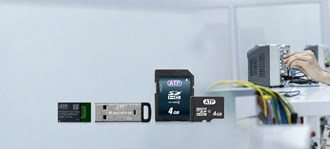
Across transport, energy, manufacturing and other embedded environments, there are still thousands of systems in the field that were designed around relatively small amounts of storage. An RTU, controller, data logger or other embedded device may only need 4GB, 8GB or 16GB to perform its job, and increasing that capacity offers little practical benefit.
The challenge is that while the requirement for low-capacity storage remains, the technologies used to produce it are changing.
The market is moving on
Flash manufacturers naturally invest in technologies that address the largest areas of market demand. Today, that increasingly means higher-density NAND and newer flash architectures.
For industrial OEMs, however, product lifecycles can stretch far beyond those seen in consumer electronics. Equipment can remain deployed for ten years or more, creating a mismatch between the lifecycle of the end product and the lifecycle of the components inside it.
As older NAND technologies are phased out, including established SLC and MLC products, engineers can find themselves facing a difficult question: what happens when the storage device at the heart of an existing design is no longer available?
And the answer isn't always as simple as buying something bigger.
Why not just use a higher-capacity device?
If an application only needs 8GB, replacing an obsolete device with a readily available 128GB or 256GB alternative may sound straightforward.
In reality, changing storage can introduce a range of considerations.
The controller may be different. Firmware behaviour may change. Power characteristics, endurance and performance can vary. Even where the interface and physical dimensions remain the same, the replacement product may still require testing and requalification before it can safely be introduced into the field.
For OEMs supporting large deployed fleets, that creates a disproportionate problem.
The storage component itself may represent a relatively small proportion of the bill of materials. The engineering effort required to redesign, test and requalify the system around a new component can be considerably more significant.
Legacy form factors create another challenge
The issue extends beyond NAND technology and capacity.
Industrial systems continue to use established form factors such as mSATA, CFast, eUSB, SD and e.MMC. As the wider market adopts newer standards, fewer manufacturers may choose to integrate the latest flash technologies into some of these older formats.
Yet those formats don't suddenly disappear from equipment already operating in the field.
For engineers, this makes lifecycle planning increasingly important. Selecting storage is no longer simply about finding a product that meets today's specification; it is about understanding how that product will be supported throughout the life of the design.
Availability versus design continuity
This distinction is important.
A component being available today doesn't necessarily provide genuine design continuity.
For industrial storage manufacturers such as ATP, supporting long-life applications means observing where industrial demand remains, understanding which capacities and form factors customers continue to rely upon, and making decisions about product support that may differ from the direction of the mainstream storage market.
ATP's renewed focus on low-capacity storage is designed around that requirement, with continued support for industrial applications using established NAND technologies alongside newer 3D TLC solutions.
The objective isn't simply to keep small-capacity products on a line card. It is to help customers reduce the risk of a storage EOL becoming an unexpected redesign project.

Start the lifecycle conversation early
For OEMs, the takeaway is simple: storage lifecycle should be considered long before an end-of-life notice arrives.
What capacity does the application genuinely require? Which NAND technology is appropriate? How long is the system expected to remain in production and in the field? And, critically, what is the supplier's strategy for supporting that design over time?
In industrial computing, bigger isn't always better.
Sometimes, the most valuable storage product is simply the one that continues to be available, consistent and fit for purpose for as long as the system needs it.
To speak to Simm's today about ATP's lineup, get in touch.