Tech Talk
Micron 9650 NVMe SSD: Why PCIe Gen6 Changes the Game for High-Performance Storage
Last updated 22 April 2026
As AI workloads scale and data pipelines intensify, storage is no longer just a supporting component, it’s becoming a defining factor in system performance. The launch of the Micron 9650 NVMe SSD marks a major inflection point, introducing PCIe Gen6 to the data centre and setting a new benchmark for high-performance storage.
Meet the Micron 9650: A First for the Industry
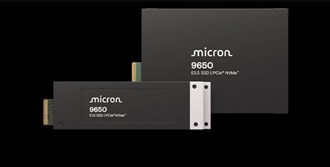
The Micron 9650 is the world’s first PCIe Gen6 data centre SSD to reach production, signalling the arrival of a new generation of storage technology.
With sequential read speeds of up to 28 GB/s and millions of IOPS, it delivers roughly 2x the performance of PCIe Gen5 drives, positioning it as the fastest enterprise SSD available today.
Built on Micron’s latest NAND architecture and designed specifically for AI and hyperscale environments, the 9650 is engineered to feed data-hungry GPUs and accelerate both training and inference workloads.

Why PCIe Gen6 Matters
PCIe Gen6 isn’t just another incremental upgrade. It fundamentally doubles available bandwidth compared to Gen5.
This step-change enables:
- Higher throughput: Faster data delivery to CPUs, GPUs and accelerators
- Reduced bottlenecks: Storage keeps pace with rapidly advancing compute
- Improved efficiency: More work completed per watt in dense data centre environments
At its core, PCIe Gen6 introduces new signalling methods and architectural improvements that allow storage devices to sustain high performance under constant load, something increasingly critical for AI workloads.
In practical terms, this means storage is no longer the limiting factor in high-performance systems.
From Storage to Data Pipeline Accelerator
The role of SSDs is evolving. In traditional environments, SSDs were designed to avoid slowing down compute. Today, in AI and high-performance computing, they are actively enabling it.
The Micron 9650 reflects this shift:
- Delivers consistent high-bandwidth throughput for large datasets
- Supports real-time data access for inference and analytics
- Scales efficiently across distributed architectures
In AI clusters, where thousands of drives may operate in parallel, even marginal latency improvements can significantly impact overall system performance.
Cooling, Density and the Next Design Challenge
With greater performance comes greater thermal density.
The Micron 9650 is designed with both air and liquid-cooled configurations, including support for E1.S form factors optimised for liquid cooling.
This reflects a broader trend: storage is now part of the data centre cooling conversation.
As rack densities increase and AI infrastructure pushes power limits, integrating SSDs into liquid-cooled environments becomes essential to maintain performance and reliability.
Final Thoughts
The Micron 9650 isn’t just the fastest SSD on the market, it represents a shift in how storage is positioned within modern infrastructure.
With PCIe Gen6, storage moves from being a potential bottleneck to a core accelerator of performance, particularly in AI-driven environments where data movement is everything.
For organisations building next-generation data centres, the message is clear: storage innovation is now central to unlocking compute performance at scale.