Tech Talk
What is High Bandwidth Flash?

Last updated 25 February 2026
In today’s data-driven world, speed isn’t just a nice-to-have, it’s mission-critical. From high-performance computing to AI workloads and real-time analytics, enterprises are pushing storage technology to its limits. Enter High Bandwidth Flash (HBF), an emerging storage innovation designed to deliver ultra-fast data transfer, lower latency, and the performance that modern applications demand. But what exactly is it, and why should your infrastructure care?
The Basics of Flash Storage
Traditional NAND flash storage revolutionised enterprise storage by replacing spinning hard drives with solid-state drives (SSDs). By removing moving parts, SSDs drastically cut latency and improved IOPS (input/output operations per second). However, as workloads grow - think AI inference, HPC simulations, and large-scale cloud services - even standard SSDs can become a bottleneck.
High Bandwidth Flash takes, or will take, this a step further. While conventional SSDs already outperform HDDs by orders of magnitude, HBF is optimised to sustain extremely high data throughput, particularly for sequential workloads and multi-threaded applications.
How High Bandwidth Flash Works
At its core, HBF likely will rely on three key principles:
- Parallelism: HBF drives use multiple NAND channels in parallel, allowing simultaneous data access. Think of it as opening multiple lanes on a highway: more cars (data) can travel at once without congestion.
- Advanced Interfaces: Traditional SATA and SAS interfaces can’t fully exploit flash potential. HBF typically leverages future PCIe Gen5 and NVMe protocols, offering low-latency, high-speed pathways directly to the CPU.
- Optimised Firmware & Controller Design: The controller orchestrates how data is read and written, balancing speed with endurance. High Bandwidth Flash controllers are specifically tuned to prioritise throughput over everything else, making them ideal for read-intensive or sequential-write-heavy workloads.
Key Benefits of High Bandwidth Flash
The advantages of adopting HBF will likely go beyond raw speed:
- Blazing Throughput: With multi-gigabyte-per-second transfer rates, applications that process huge datasets - like video rendering or AI model training - see immediate improvements.
- Lower Latency: Faster response times mean less waiting for critical data, which is essential for real-time analytics and HPC clusters.
- Scalability: HBF allows data centres to handle larger workloads without massive infrastructure expansion. More performance per drive often translates to fewer drives, lower power, and reduced cooling demands.
- Reliability: Enterprise HBF solutions come with robust endurance ratings, ensuring consistent performance even under heavy load.
It's real, but early
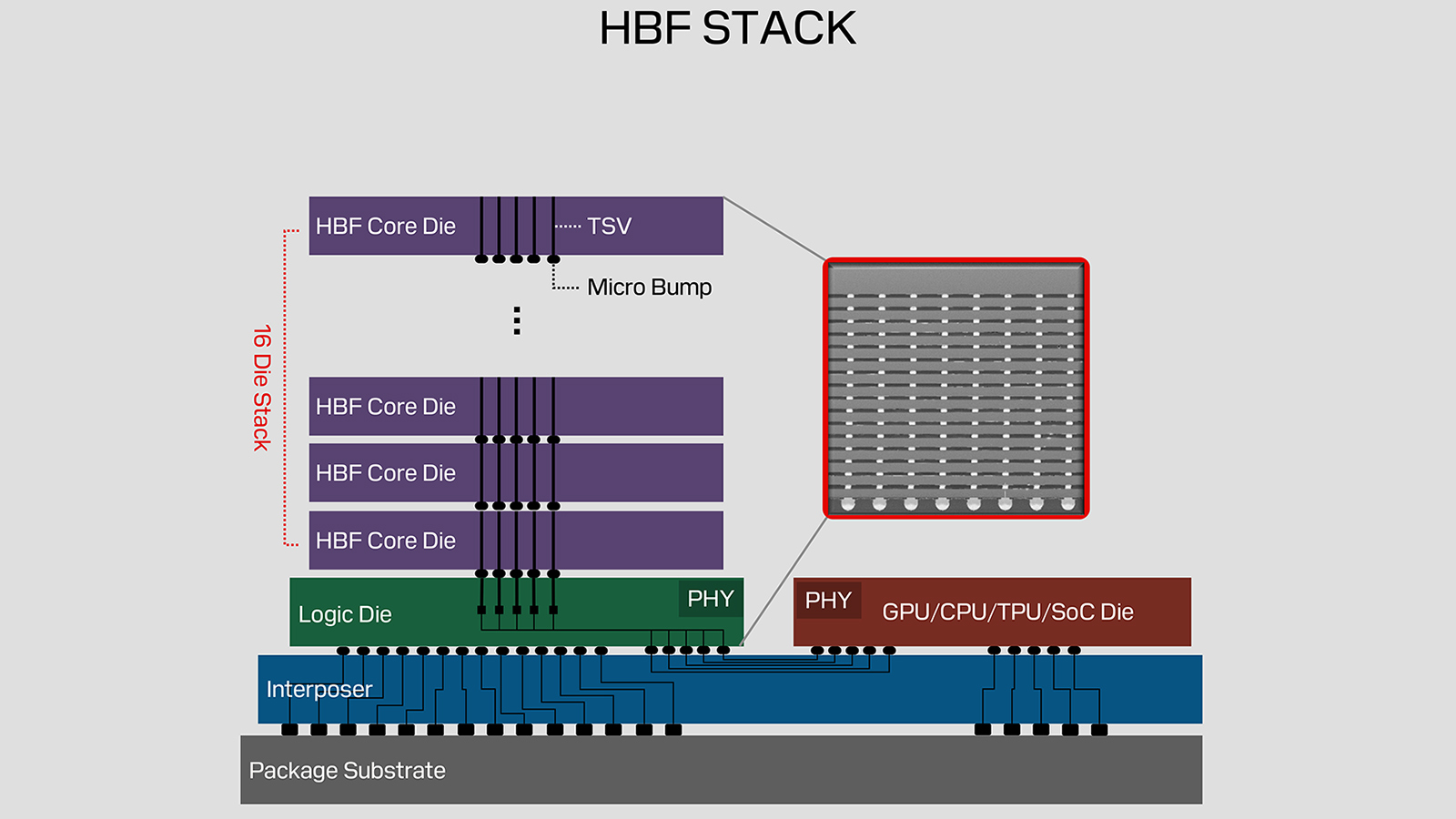
Companies like SanDisk have publicly unveiled High Bandwidth Flash architectures that blend high-capacity 3D NAND with wide, parallel data paths to approach the kind of throughput traditionally found in High Bandwidth Memory (HBM) modules.
Likewise, SanDisk and SK hynix are working together on standards to push HBF forward, with sample hardware expected later in 2026 and first systems using the technology targeted for 2027.
Even in prototype form, High Bandwidth Flash signals a shift in how storage and memory might be designed for AI, HPC, and large-scale analytics - blurring the line between persistent storage and high-speed memory. By stacking and parallelising NAND flash and using wide data interfaces, vendors aim to dramatically increase bandwidth while keeping the terabyte-scale capacity flash is known for.
Potential Use Cases
High Bandwidth Flash isn’t for every workload. It’s designed for situations where data movement is the bottleneck, not storage capacity. Typical applications include:
- AI & Machine Learning: Training models require constant high-speed access to massive datasets.
- High-Performance Computing (HPC): Simulations and scientific computing need predictable, high-throughput storage.
- Media & Entertainment: 4K/8K video editing and rendering pipelines benefit from sequential read/write acceleration.
- Neocloud & Hyperscalers: Multi-tenant environments rely on speed to ensure consistent service quality.
High Bandwidth Flash isn’t just a faster SSD - it’s a performance multiplier for the modern data centre. By combining parallel NAND channels, advanced interfaces, and intelligent controllers, HBF delivers the throughput and low latency that next-generation workloads demand. For organisations looking to stay ahead in AI, HPC, and cloud services, it’s not just an option, it’s becoming essential.